A short exchange with a facilities engineer in Saudi Arabia exposed something the construction industry rarely admits the BIM model that looked perfect at handover is often already wrong by the time someone has to maintain the building.
The problem in one image
You're standing in front of a wall. The drawing in your hand says there's a chilled-water pipe behind it. There isn't. The pipe is three metres to the left. Nobody wrote that down.
The BIM model on the Facility management company's server still shows the original design. The as-built drawings say the pipe is exactly where you're standing.
You're the facilities engineer. It's four in the afternoon, a tenant just called about a temperature drop on the seventh floor, and you have to decide whether to open the wall or spend another two hours chasing the real route. This building was handed over three years ago. The construction team is long gone. Their BIM model was, at some point, coordinated beautifully.
None of that helps you right now.
Meet the FM voice in this piece

Tariq Alaroui
Facilities Engineer · EFSIM Facilities Management Company
Al Madinah, Saudi Arabia
14+ years in HVAC, refrigeration, and BMS systems across large-scale facilities, currently working at the King Salman International Conference Centre in Madinah.
Featured with permission. Quotes reproduced from a direct LinkedIn exchange, July 2026.
The conversation
I asked Tariq a direct question: does the BIM model actually help facilities management day-to-day, or does it get left behind after construction ends?
His answer was sharper than I expected:
A well-developed BIM model can be extremely valuable after handover but only if it is properly maintained and handed over with accurate asset information.
When integrated with FM systems such as CAFM or CMMS, BIM becomes much more than a 3D model. It helps us quickly locate assets, access maintenance data, review equipment specifications, plan maintenance activities, and reduce the time spent troubleshooting issues.
Unfortunately, in many projects, the BIM model is not updated to reflect the as-built condition or isn't integrated into FM workflows. In those cases, it often ends up being underutilized after construction.— Tariq Alaroui
I followed up with the question I most wanted answered. When the as-built model is wrong, how does the Facilities management team find out?
Is it during commissioning, or years later during a live fault?
From my experience, we usually discover discrepancies during maintenance activities, inspections, equipment replacement, or when troubleshooting a fault. That's when the team realizes the model or drawings don't match the actual installation, leading to delays and additional site verification.
This is exactly why keeping the BIM model updated throughout construction and handover is so important. An accurate as-built model becomes a valuable operational asset, not just a project deliverable.— Tariq Alaroui
Read that again. Every fault. Present tense. Every time. On a live fault, with a tenant complaint or an equipment failure driving the clock, the Facility Management engineer opens the drawing and finds out for the first time that the drawing is wrong.
The cost of a broken BIM handoff
Multiply that across every fault, every inspection cycle, every equipment swap-out, across the twenty-year operational life of a building. The real cost of a bad handover doesn't show up on the construction contractor's balance sheet. It shows up on the Facility Management contractor's as:
- Reactive maintenance that takes longer than it should — every fault begins with a verification step that shouldn't be needed.
- Planned maintenance that gets less accurate — asset locations, specifications, and access routes on the model don't match the field.
- Equipment replacement that gets riskier — technicians arrive with specs that describe a different unit than the one actually installed.
- Compliance and safety exposure that quietly rises — as-built documentation is treated as authoritative but isn't.
- Building-owner trust that erodes — the FM contractor keeps discovering things that should have been documented years ago.
None of these is the Facility Management team's fault. But all of them land on the Facility Management team's desk.
Where BIM earns its keep in FM
Tariq didn't dismiss BIM. He described exactly what a working BIM handover unlocks for facilities management teams:
- Asset location in seconds — find the isolation valve before you open the wall.
- Maintenance planning against reality — schedules that reflect what's actually installed.
- Equipment specifications on-demand — the right part number, torque spec, or procedure without digging through five PDFs.
- Faster troubleshooting — a trusted 3D view is the difference between a two-hour fault and a six-hour one.
- Full lifecycle continuity into CAFM and CMMS — BIM stops being a deliverable and starts being an operating system for the building.
Every one of these depends on the same precondition: the model matches the building. Break that link, and none of the five works.
How DeltaARBIM closes the loop
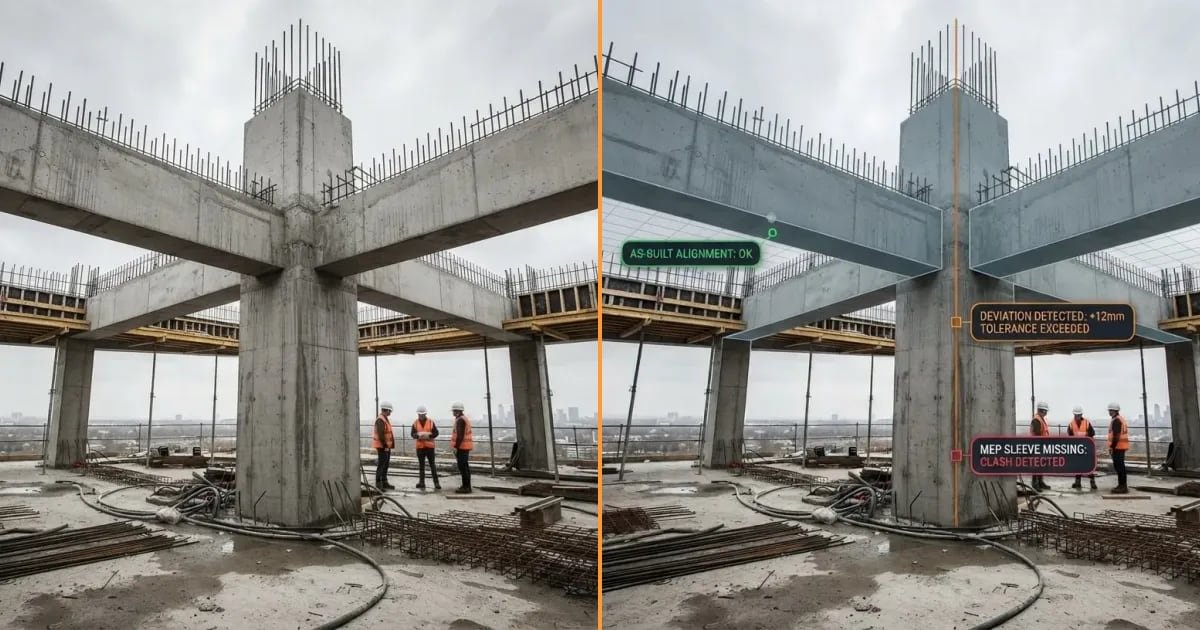
Here's where DeltaARBIM fits in, and it's important to be precise. DeltaARBIM doesn't solve every problem Tariq described. What it solves is the specific construction-side failure that creates most of Facility Management companies' problems: nobody proves the build matches the model during construction.
Here's how it works on site:
- Load the model. Import your IFC, Revit, or Navisworks model directly into DeltaARBIM on an iPad Pro or iPhone Pro.
- Anchor to reality. LiDAR and GPS anchor the model to the physical site with ±2 cm precision.
- Walk the site. Toggle layers — structure, walls, HVAC ducts, water pipes, electrical containment — and see them overlaid live through the camera.
- Catch drift immediately. Any deviation between model and reality is visible in real time — not weeks later, not years later.
- Log and hand over. Every check is timestamped, photo-verified, and site-anchored. By handover day, the as-built model is the building.
The result: the FM team inherits an asset, not a puzzle.
What both sides of the industry can do differently
For construction and AEC teams: stop treating as-built documentation as a paperwork task. Verify the build against the model during construction, not after. The tools exist. What's missing is the discipline to use them.
For building owners and FM contractors: a "BIM Level" clause in a construction contract is not the same as a guarantee that the model will be usable in operations. Ask specifically: how was the as-built model validated against the physical build? Who signed off? Is there evidence of alignment checks during construction, or only at completion?
Thank you, Tariq
Tariq, thank you for this conversation. Fourteen years on the FM side of the industry gave your perspective a weight that no marketing brief could ever match. Your willingness to share your experience openly with your name, your photo, and your voice makes this piece worth publishing. The industry is better for engineers like you who quietly carry the cost of every construction shortcut, and still take the time to explain how it could be done better.
Your closing sentence stays with me: "An accurate as-built model becomes a valuable operational asset, not just a project deliverable." That's the standard construction should be measured against. We'll do our part to help the industry meet it.
With respect and gratitude,
Aman Solanki
DeltaARBIM · Shivlam
See it in action
If any part of Tariq's experience sounds like yours, whether you're the one inheriting broken models or the one shipping them, DeltaARBIM can show you what a verified BIM handover actually looks like on a real site.
- See and book a 20-minute demo: deltaarbim.tech/demo
- See the platform: deltaarbim.tech
- Talk to the team: build@deltaarbim.tech · WhatsApp +91 8460 47 1281