Rework costs more on a data centre than on any other building type. Revenue starts at energisation, white space is packed tighter than almost anywhere in construction, halls repeat by design, and a live facility cannot be reopened to check.
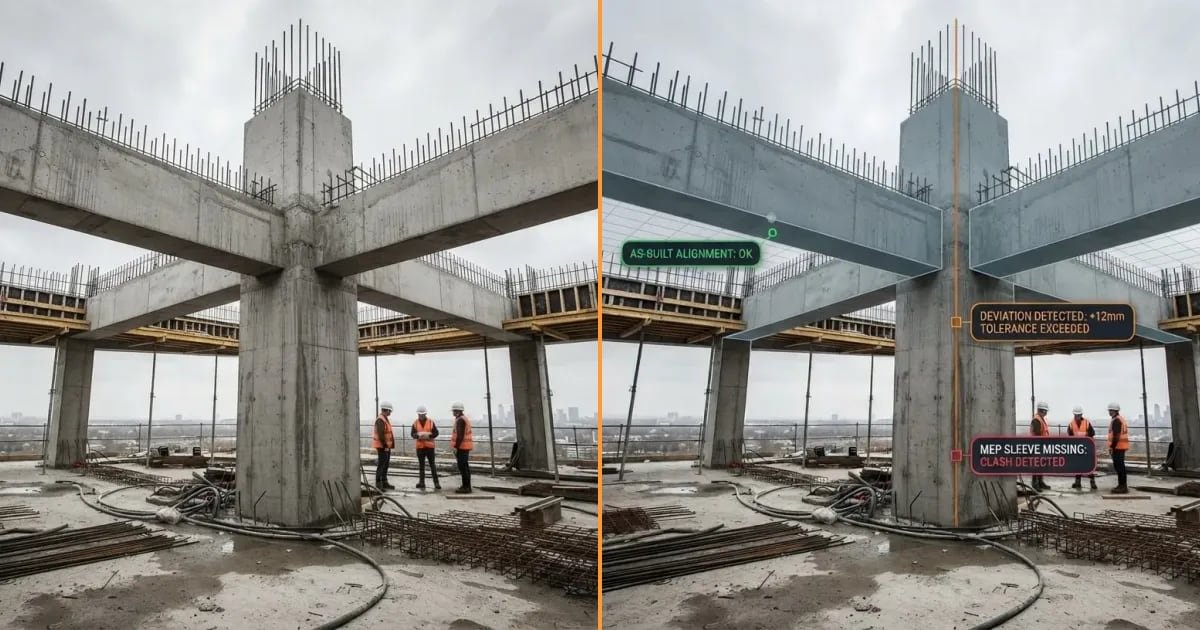
As-built verification is checking that what was built matches the approved model, within tolerance. On a data centre, that check is worth more than on any other building type.
Here is what that is worth in numbers.
| $81.5B US spend, H1 2026 |
$570 median cost per sq ft |
5 to 9% rework, of contract value |
$30 to 54M exposure on a $600M build |
Sources: ConstructConnect Data Center Report, August 2026. Rework range, Navigant Consulting.
US data centre construction passed 50 billion dollars annualised in April 2026, overtaking all transportation infrastructure spending for the first time (US Census Bureau, reported June 2026). The buildout is enormous. So is the exposure inside it.
How is data centre construction different from a typical commercial build?
Same disciplines. Very different consequences.
| Factor | Typical commercial | Data centre |
|---|---|---|
| Delay cost | Extended programme cost | Lost revenue on pre-sold capacity |
| Services density | High in plant rooms | High everywhere, floor and ceiling |
| Repetition | Floors vary | Halls repeat by design |
| Error multiplier | Usually contained | One pattern, many halls |
| Post-handover access | Maintenance window | Change control against uptime |
| As-built accuracy | Useful | Operationally critical |
Why does finding a deviation late cost so much more?
Because every stage that passes adds work to the fix.
| In the model | A few clicks. Baseline cost. |
| On site, still exposed | Labour and materials. Recoverable. |
| After the ceiling closes | Demolition, resequencing, trades back on site. |
| After energisation | Change control against live uptime. Highest cost. |
We wrote about the same problem at ordinary commercial density in our post on the ceiling void, where services are dense but the stakes are lower.
Why does repetition change the maths?
Repeatability is the efficiency argument for modular data centre delivery. It works just as hard against you on error. The same logic applies to repeated precast elements, where one misaligned embed becomes a pattern rather than an incident.
How does on-site verification help?
Coordination decides what should be built. Clash detection resolves conflicts in the model. Neither confirms what actually got installed.
That is the gap we cover. We overlay your approved IFC model onto the physical structure using an iPad and LiDAR, at plus or minus 2cm, so your team can walk a hall and see built against designed while a fix is still cheap.
| Capability | What it means on a data hall |
|---|---|
| Plus or minus 2cm | Position checked against the approved model, not sampled by tape |
| iPad and LiDAR | A walk, not a scheduled survey visit |
| IFC-first | We read the coordinated model your team already issued |
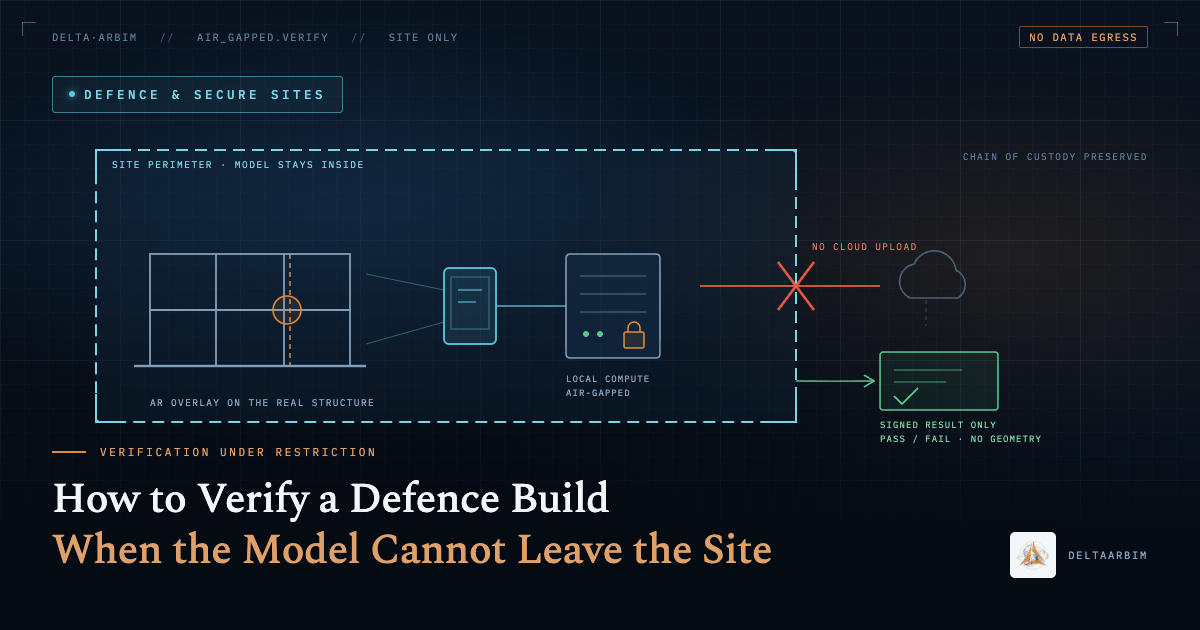
| Self-hosted | Facility data stays inside your environment |
| Verified as-built | Handover record for a facility that cannot be reopened |
From the field
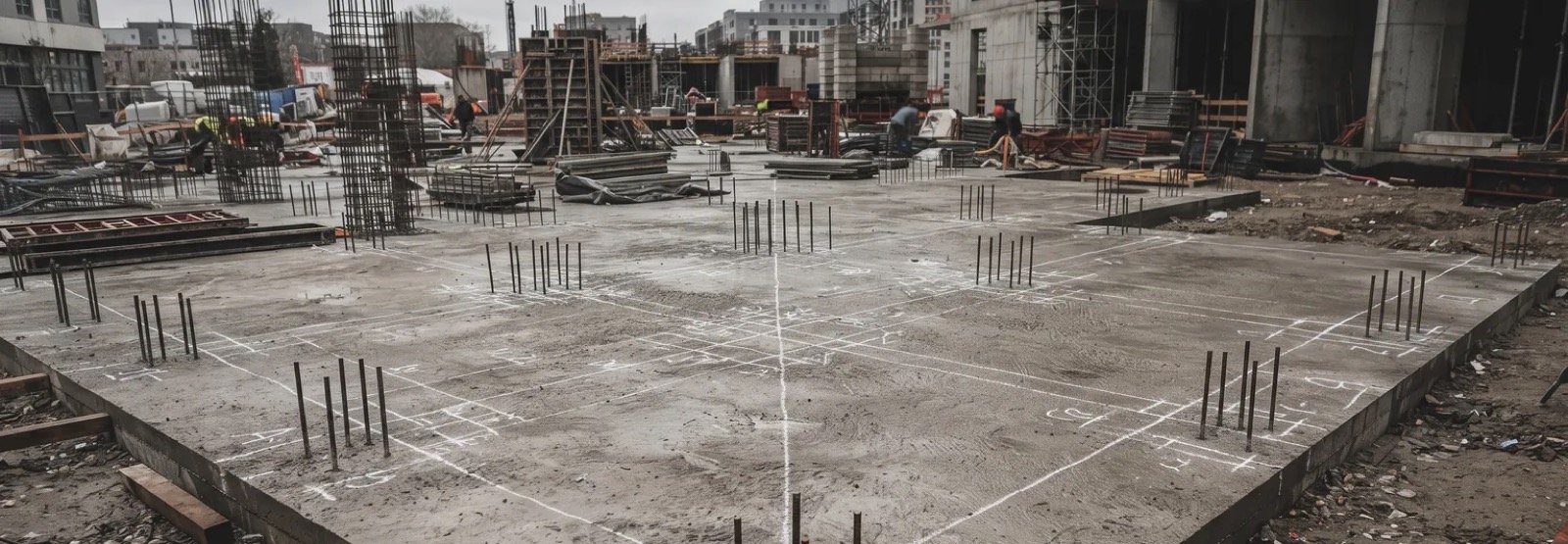
We verified 152 structural elements in position against the model at plus or minus 2cm, on a real slab, before the following trade began work on top.
What sequence should a data centre programme follow?
Four steps, and most programmes run only the first.
| # | Stage | What good looks like | Owner |
|---|---|---|---|
| 1 | Coordinate the model | Federated, clash-free, issued as IFC | BIM and VDC team |
| 2 | Verify hall 1 | Treated as the prototype, because it is | GC and QA/QC |
| 3 | Carry findings forward | The pattern fixed once, not eight times | PMC and GC |
| 4 | Hand over a verified as-built | Into a facility that cannot be taken offline | Owner and FM |
What we do not do
We do not author your models, run your coordination, or replace commissioning. We confirm that what was built matches the model your team already produced.
On a building type where errors repeat across halls and finished work cannot be reopened, that confirmation is worth having early. You can see the full capability set on our features page.
A question for data centre teams
What is the latest you have ever found a deviation on a build? Before energisation, or after?
Market figures: ConstructConnect Data Center Report, August 2026.
If you are delivering data centre capacity and want to verify hall 1 before it repeats, email us at build@deltaarbim.tech.